Allegra's Trans Experience

Here to share my story.

  • (TW: transphobia)

    Just like it was for most of the trans community, 2025 was a tough year for me.

    At the beginning, I was reeling from a breakup with someone I had been with for two years, and thought was the one. I gave her so many chances to grow with me and love the real me, but she was more interested in having everything her way and trying to bring back my old self. I was scared beyond belief of the incoming presidential administration in the States, thinking it was only a matter of time before I would lose my right to transition, or even exist as a trans woman in my home country at all. On top of that, I felt dismissed and ignored by my ex, my family, and even my therapist, since none of them seemed to understand how much danger I felt I was in.

    All of them kept telling me “Oh, Trump can’t take away your rights, you’re catastrophizing!” They ignored all the obviously hateful and transphobic propaganda that Trump and his cronies kept spewing towards us, and the fact that so many people were already losing rights thanks to the recent Supreme Court decisions and billionaires buying out politicians in both major parties.

    The only people who seemed to empathize with what I was going through were my friends. And even so, I struggled a lot with being vulnerable and asking for help. I didn’t want to seem “too much” out of fear that I would get hurt again, like I did in my relationship with my ex and with my parents.

    So what did I do? I moved to Spain through a teaching abroad program, hoping to start a new life.

    I got my TEFL (Teaching English as a Foreign Language) certificate, took Spanish classes, and applied for English teaching jobs in the Madrid area. I made some new friends and even started dating someone new, beginning my first real lesbian relationship! As lonely as I was in the beginning, it seemed like things could work out for me there.

    But it took me until September to finally land a teaching job, and when I did, it was as an auxiliar (English language assistant) in a public school in Getafe. So instead of the smaller classes with adults that I did my teaching practices in, I was put in classes with twenty to thirty children and expected to plan lessons for all of them. However, I was being paid only 900 euros a month while working four school days a week, which was barely enough for me to afford my rent, food, and hormone therapy.

    I would come home absolutely exhausted from my job, and still be expected to plan lessons for the next day. Although my position was “language assistant”, I was expected to act like a professional teacher, while getting paid very little and feeling all alone due to being the only trans woman there.

    Worse still, I was asked the question “Are you a boy or a girl?” by eight different students, all boys, in the first two weeks of working there. On top of that, I heard racist and ableist jokes from several students, some of them as young as seven years old. They natively spoke Spanish so they probably didn’t think I would understand them, but I did. I even got called a boy twice, despite clearly presenting as a woman. And it hurt.

    When I tried to bring this up with my coordinator, he told me that a lot of the students come from conservative families and that they wouldn’t understand my identity, so I had to be patient with them. I understood where he was coming from, but that didn’t change how hostile the environment felt to me. And I didn’t believe that the kids truly couldn’t understand someone being trans. After all, they already knew how to bully people that didn’t look or act like them, and disrespect their trans teacher!

    On top of that, at a later meeting with my coordinator, he also told me that the students’ parents were complaining about their kids being “indoctrinated” just because I talked about how some families have two dads or two moms, and that boys can wear skirts and become girls, even though they were relevant to my lessons about family and clothes respectively. Apparently even that was too “political” for them. This was exactly the kind of ridiculousness I hoped to leave behind in the States after I left my teaching career there, and yet I was dealing with the same thing! I couldn’t take it anymore.

    Things started to go downhill in my personal life too. I broke up with my new girlfriend in October due to struggles with us being long-distance and me not knowing how much I meant to her. Most of the initial friends I made last spring ended up moving back to their home countries. I had never felt more alone at that point.

    All of this affected the quality of my lessons, and my ability to show up at my job. It got to a point where many parents and teachers didn’t even want me there. So my coordinator gave me an ultimatum; that I would have to deliver perfect lessons for the next week and a long time afterwards, or I would be dismissed. Initially I thought “ok, I’m gonna try a lot harder and give the best lessons I possibly can.” But as I came home that day, I did some soul-searching.

    I asked myself, “Is this really what I want? To give it my all and be perfect for a job where I’m facing transphobia on the regular and not being given any support for it? And in a field that I already had to leave behind in my home country because of the same problems I’m facing here?”

    After that, I decided it was finally time to leave teaching behind for good. I was finally learning to live my truth, and I wanted to put real effort into my friendships and form my own chosen family. I couldn’t stay stuck in a career that demanded that I sacrifice those things.

    I was crying almost every day the week that I quit my job. Afterwards, I cried much less often.

    That being said, I had no idea where to go next. I thought I would find an au pair or long-term house sitting job in another trans-friendly country. But one day shortly after I quit, one of my best friends from back home called me. When I told her my situation, she suggested that I come home, saying that so far New Jersey has still been safer than most places in the States, at least for her and the others in my old community.

    For so long, I was terrified of the thought of returning to the States. But then I realized something. There were still so many trans people I was friends with and influencers I followed who were still alive and visible, and still fighting for their rights. I saw reports of everyday people protesting and running ICE out of their cities to protect their immigrant neighbors. Even through simply scrolling through Instagram and Threads, I heard stories of new trans people coming out and starting HRT, with help from their families and communities. Several progressive (or at least non-Republican) candidates also won local and state elections across the country, most notably Zohran Mamdani being elected mayor of New York City and Mikie Sherrill winning the race for governor of New Jersey. Through hearing this and speaking with my old friends, I became filled with hope. I was still afraid of coming back, but I also started to have more faith that my community, my people, would be there to protect me.

    I learned this past year that safety means more than just having rights. It means being cared for and protected. Being loved, held, and understood. Feeling wanted, celebrated, and like you can be yourself and still belong. I’ve always wanted (and needed) that, but my past experiences made me internalize the beliefs that I was the only one who could truly support myself the way I needed, and that I couldn’t be too emotional or needy around anyone or I would get hurt or left behind. These intense feelings of fear and aloneness made me lose sight of how much support I really had, and what I really wanted.

    I also learned that I don’t need to shrink myself to be loved and supported. I stood up for myself more this year than I ever did in past years, leaving several situations where I was being used, neglected, and/or dehumanized. I finally gained the courage to tell the world, “Not anymore. This is my life, not anyone else’s.” I learned that I can do so and still be a kind person, and still be loved for it. Every time I set a boundary or left a toxic situation, I told my friends. And they told me they were sorry I had to go through that, but also that they were proud of me, and that they were glad I got out. But most importantly, I’ve learned that the right people for me, as busy as they may be, will make time and energy for me as I would do for them.

    So for 2026, my biggest goal is to build the chosen family of my dreams. I will find other people who are making friendship a priority in their lives, whether they’re already friends with me or not. I will get involved in community events, and take part in new hobbies where I can meet more like-minded people. I will still focus on building my career as a writer, but I still deeply value human connection and I need that in my life if I am to thrive. I want to be truly seen, loved, and understood, and to feel safe enough to slow down around the people who love me. I know that that is the best way for me to heal. Because no matter what Instagram self-care posts tell you, true healing doesn’t happen only in isolation. It happens through authentic community care and love.

    I’ve come this far believing in myself. So it’s time I started believing in others too.

  • Romance may be exciting. But friendship is just as loving and meaningful, if you do it right.

    When I was in college, as soon as things opened up and more and more people got vaccinated against COVID, I started wearing a pin saying “Free Hugs (if you’re vaccinated).” I would always offer hugs to anyone I hung out with, and I became known for that. I met several of my best friends that way. I hosted movie nights too since I didn’t have much interest in partying and drinking, and wanted to build community elsewhere. My friends loved it, and I was happy to support them.

    That being said, however, I was a people-pleaser, and there were a few people who took advantage of my acts of kindness. They would go to me for all their emotional needs, but when I needed their support, they made excuses and complained that it was too hard for them. I stayed with them out of fear that they would hurt me, or that their problems they frequently reminded me about would get worse. And the worst part was, every time this happened, it was someone who either had romantic feelings for me, or was already dating me. And they only fell in love with their idealized version of me, not the real me who was buried inside.

    I grew up with a dysfunctional family that taught me I had to perform to be loved, and as a result, I was afraid that expressing my needs too much would label me a manipulator, or that I would end up putting someone else through what I have. So it made sense that some would try to put me on a pedestal and think of me as some savior who met all their needs and didn’t need reciprocation. Or, like the one who would replace their father. (This was before I came out as a trans woman).

    This was the reason I left my first two romantic relationships. It’s also one of the biggest problems with the common narrative of romance. Many of us are conditioned by modern media to believe that we have to find “the one”, and that this one person (who is almost always the opposite gender from you) will fix all of your problems and take care of all of your needs. As a result of that, a lot of people, especially straight people and gay/bisexual people that struggle with compulsory heteronormativity (or comphet for short), will base their entire social lives on finding a partner. Once they do, they will end up either manipulating them, or getting manipulated themselves. Before I transitioned, I found myself in these relationship dynamics a lot, since I didn’t fully know who I was when I wasn’t helping others.

    But when I came out as trans, I broke that cycle. I found my own sense of self. And when my family and ex refused to properly support me, my friends stepped up. They didn’t just support me, they celebrated me.

    My friends wanted to see me grow. They hugged me and told me they were proud of me, and that I was a very pretty girl, and that they loved me. They truly made me feel like the real me belonged with them. And they made an effort to see me and spend time with me when they could. Because they loved the real me, not just the version of me they initially met. Many of them could tell I was a girl even before I could!

    A lot of people see friends as placeholders in their social life, or just people they hang out with out of convenience. But real friendship is a lot more intimate and requires a lot more commitment than that. Real friends show up and support you. They take time out of their day to be with you. They make an effort to truly know you and be there for you, and make you feel loved. They’re not just there to play catch-up and share drinks, they’re there to truly connect with you and make life more enjoyable and memorable.

    Most people don’t know how to forge such a connection with anyone but their romantic partner. But it is possible to have platonic relationships that are just as strong and loving, as long as you and your friends are all committed to it. And we need it more than we realize, especially those of us who didn’t grow up with supportive or loving families. For us, if we let them, our friends can become the best family we’ve ever had. And we need that in our lives. Because that might be the only place where we truly feel seen and loved.

    Whenever I spend time with close friends, I’m incredibly sappy. I go out of my way to let them know how much they mean to me. I make plans with them and consider them. I hug them and tell them I’m so grateful they’re here and that I love them. Because I do. I love them just as much as anyone I date. I just don’t want to kiss them or have s*x with them. But that doesn’t mean they mean any less to me. I don’t think of romance as more than friendship, just different.

    My friends are the reason I believe in love, both platonic and romantic. In fact, I like to fall a little bit in love with all my close friends. Not in an “I want to date them” kind of way, but in a “I find them so cool and they inspire me so much, anyone would be lucky to have them in their lives” kind of way. But if a friend I felt particularly close to were to ask me out, and we were both in the right headspace, I wouldn’t object. After all, who could make a better life partner than a best friend?

    The point is, friendships can be so much more intimate than we realize. Not as in “friends with benefits”, but as in close emotional safety. Healthy and emotionally safe friendships can even help you heal and learn to rest when you’re exhausted or hurt. You can take friends out on dates, cook dinner for them, have long and deep conversations, do a marathon of your favorite show together, and even cuddle with them if you all feel safe enough and consent to it!

    I’m not saying you should demand romantic relationship benefits from your friends. Of course you should still clearly define whether a relationship is romantic or platonic. I’m saying that friendships can be just as meaningful if both parties put real effort into them. And when you’re with friends that treat you like family, you learn what healthy relationships really look like. That’ll help you learn to love not just those friends, but yourself, and your current or future partner, even better.

    Although this post has primarily been about friendship, I also value romance a lot too. But I don’t want my partner to save me. I want my partner to grow with me. In fact, I would love for my future partner to be part of my chosen family too. We don’t necessarily need to start out as friends, but I consider it a huge green flag for them to value their friendships and treat our friends like family too. Learning to rely on more people than just one romantic partner for support doesn’t mean your relationship is weaker. On the contrary, it means the relationship is stronger than ever. Because that way, both of you can approach the relationship as your authentic selves and develop a deeper level of trust and intimacy that is only possible once you learn to do so.

    I’ve always been obsessed with media that features the chosen/found family trope, most notably shows like Avatar: The Last Airbender and Heartstopper. Both of those shows feature groups of friends that come together to support one another, as well as romantic relationships that develop between certain members of the group. They don’t portray romance as more or less important than friendship, but instead paint both as parts of a greater whole, leading to healthier and more loving dynamics throughout the entire group. While Heartstopper may have a more central focus on the romance between Charlie Spring and Nick Nelson, the two also have a solid group of mostly queer friends that regularly express their love for one another and make each other feel safe.

    Honestly, I’ve always wanted to have a close group of friends like the ones featured in those shows, or the various fiction novels I’ve read and role-playing video games I’ve played. And I’m not the only one who wants that. But to have those friendships, you need to be that friend. Think about that before you cancel plans with someone you know out of tiredness, tell them you’re busy without following up, or ignore a message from them. Obviously you should reschedule if you’re feeling sick or swamped with work, but you don’t always have to show up as your best self. Your best friends will love to see you whether you have a face full of makeup or just rolled out of bed, whether you’re jubilant and happy or tired and sad. They will want you there. But you have to make that effort for them.

    So make those plans. Show up on time. Put your phone away when you’re with them. Ask them to do things with you. Make it known that you want them to be there. Actively choose to spend time with them. And if they’re not willing to reciprocate, that’s on them, and someone else will. But when someone does, hold them tight. Keep them close to you. Do that, and you will feel happier than ever.

  • Imagine you’re hanging out with your best friend, or your child. You’re getting into a deep conversation, or mentioning something important to you or them, and then they come out and tell you they’re trans. They ask you to use new pronouns for them, and to call them by a new name. You care about this person (or at least they hope you do), and you might have the instinct to tell them “I don’t care that you’re trans, whatever you are I love you.” But that’s where many well-meaning cis people go wrong.

    “I don’t care that you’re trans” may seem like support, but it’s really negligence.

    “Not caring” about transness is problematic towards trans people for the same reasons “I don’t see color” is problematic towards Black people. It ignores an essential part of who we are. If you don’t care that someone in your life is trans, then you also don’t care that they’ve had to fight harder than you can imagine just to live as the gender they know they are. Or that they currently face violence in several countries just by daring to be themselves.

    Plus, a lot of people who say they don’t care will use that to cover up their bigoted views. They will still deadname and misgender their trans loved ones, and complain that we’re “indoctrinating kids” and “shoving it in our faces” when we talk about our identities and express ourselves. They’ll also likely buy into common transphobic right-wing talking points about sports, bathrooms, or “biology”, or ask us invasive questions about our bodies. Or try to frame transness as a “choice” rather than a lived identity. At the very least, they’ll do nothing when we get attacked or kicked out of our homes and safe spaces by transphobes. That’s the same as siding with the oppressor.

    In other words, not caring also means not listening.

    If you’re reading this and your first instinct is to get defensive, and say something like “But I’m an ally!” or “But I’m not transphobic!” ask yourself why. Think about where your defensiveness and your urge to disregard someone’s differences come from. They probably come from what you were taught as a kid.

    It’s easy to think you’re a good person. It’s harder to step up and do good things.

    In school (or at least in American schools), we’re taught to discard other people’s race, gender, sexuality, disability, etc. and just see people. But you can’t see someone as they are without seeing what makes up their identity. And disregarding these differences only keep people from really learning about them, and encourage people to frame them as bad things. People are afraid of what they don’t know.

    It’s easy to think you’re a good person. It’s harder to step up and do good things. Especially when so many others don’t approve of it. But that’s what being an ally means. It takes courage.

    So what should we say instead?

    Give them a hug. Thank them for trusting you enough to tell you. Tell them you’re so proud of them. Ask them what new name/pronouns to use for them. Do whatever you can to make sure they feel as loved and safe as possible. Respect their boundaries surrounding coming out. Support them however you can in reaching their transition goals. And keep celebrating them. All the time. Not just when it’s convenient for you.

    Trans people are being attacked from all sides now. We can’t afford for it to “just take time” for you to accept us or get used to us. We need support and action NOW. If you’re too afraid to support us, or if you make it about yourself, or if you try to be neutral or take the easy way out, you’re a coward.

    We need to be loved and cherished while we’re here, not just when we’re gone.

    Not long after coming out, I had to cut ties with my then-partner, my father, and half my family after they attempted to manipulate and guilt me into detransitioning. And they were people who said they “weren’t transphobic” and “didn’t care” that someone they knew was trans. Yet they made me feel more hurt and alone than any run-of-the-mill Internet bigot ever could. Because they were afraid of losing their privilege. Their behavior was bigotry disguised as concern and grief over the older version of me, the one that they thought they could control (or in my ex’s case, the “man” she thought would replace her father).

    But you wanna know who did show up for me? My friends.

    My friends were the ones who hugged me and welcomed me. They celebrated me. They asked me continually how they could make things better. They were there for me when I started transitioning, when I cut off my family, when Trump got elected and I was devastated, and through all the challenges that followed. And they were there because they chose to be. Not because of some legally binding contract, romantic partnership, or fear that I would leave them. But because they wanted to be there. I’ll never forget them and I’ll always be grateful for them. My friends are my chosen family.

    And yet, after last year’s election, I had never felt more scared and alone. Because I was still so new to being trans, and I was manipulated and abandoned by people who signed up to support me. And on top of all that the new president and half my home country’s government wanted everyone like me dead, and most of the other half didn’t even care about us at all. When I traveled to Spain earlier this year for an English teaching abroad program, I only did so because I wanted to escape the States. All I wanted to do was run away.

    But even so, my friends supported me in any way they could. They cherished me for me, and they continue to do so today.

    Every trans person needs a loving family and home. Whatever form it may take, we need to have people around us that love us and help us rest. We’ve been fighting just to be seen for so long, only to come home to unloving, or worse, hateful, environments. That needs to change, and we can’t afford to wait for that. We need to be loved and cherished while we’re here, not just when we’re gone.

    This took me a lot of vulnerability to write. But it needed to be said. We, as a vulnerable community of people, need you. As allies, you and your friends/loved ones can provide us with consistent love and understanding, and safe and loving spaces that we need. Own up to your past mistakes and become safer people. Don’t get weird about using our chosen names and pronouns or dating us. Be our friends. Make it normal to love us. Make us feel important. Be loud in your support of us. And love us BECAUSE of our differences and the things that make us who we are, not in spite of them. Whether your love is platonic, romantic, or familial, we will appreciate it more than you know.

    You have more power than you realize. Use it for good.

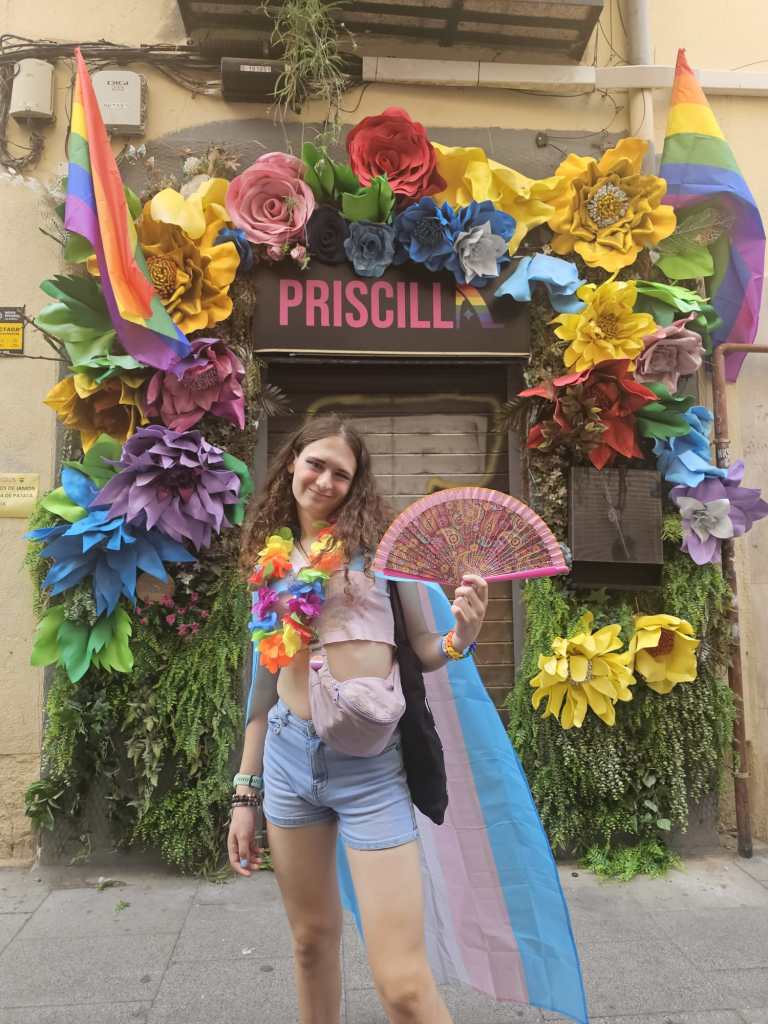
  • Photo of Allegra at Madrid Pride 2025

    I’m not just a trans woman. I’m a lesbian too.

    My journey to discovering my gender and sexuality, and the relationship between the two, has been anything but linear. When I first started questioning my sexuality, I thought I might be demisexual since I only seemed to catch feelings for people after making friends with them, and on top of that I was afraid of deeper intimacy with people. But turns out, that fear came from gender dysphoria.

    Demisexuality

    Only experiencing attraction after developing a close emotional relationship with someone.

    I didn’t understand my gender and was wearing masculinity as, well, a mask, plus I didn’t understand my body either. I felt empty, like something was missing from my body and my soul, and I was repulsed to most forms of intimacy beyond cuddling and kissing because of that.

    Even so, I was dating people while questioning my sexuality and gender. I thought that I was bisexual for the longest time, since although I’ve only dated women, I also deeply admired a few certain male celebrities/fictional characters. Plus, nearly all my friends were bi, and I was getting more and more in touch with my emotions. So I had to be one of them in some way, I just didn’t know what way. All I knew was that I did mainly like girls, just not in a straight guy way.

    When I came out as a trans woman, I still thought I was bi. But then, a year later, I went out on a first date with a girl in Madrid while I was doing an English teaching program there. When I explained my sexuality to her, she asked me “Are you sure you’re not a lesbian?” And that’s when it hit me.

    I am a lesbian. I just liked fictional men since they were usually kinder and more loving than most men I met in real life. And I’ve had bad experiences with men. But those experiences aren’t what made me figure out I was a lesbian. What did was the realization that I could never feel the same way for a man that I could feel for a woman. I was just afraid to call myself a lesbian since I was still new to being a trans woman, and I was afraid that I didn’t pass enough and that transphobes would see me as a straight guy. My last relationship, short as it was due to long distance and constant confusion about where I stood in it, did help me realize that and I am grateful for it.

    I’ve also learned that when I catch feelings for someone, I’m inspired by them. Seeing them and giving and receiving love from them makes me want to better myself. So when I started feeling deep admiration for someone in my life, I often thought “Do I want to be with this person, or do I want to be more like them?” Turns out, in most cases, it was both. I started picking up on little things they did, or their acts of kindness, and practiced doing them myself. Not necessarily to impress them, but to understand them better. Plus it was so much fun!

    Anyone who knows me in person knows that I love hugs. A lot. I’m always hugging my friends and letting them know how much they mean to me. That’s always come naturally to me, but I was forced to repress it for years before finally meeting someone who would love me for it. That someone was my good friend Seriah, who I met when I was a freshman in high school. We were track teammates, and she would often give me a hug as I held the door open for the other athletes before we went off to practice. Her hugs and positive energy made me feel so safe and loved, which inspired me. I wanted to give my other friends the same feeling that she gave me when she hugged me.

    My friendship with Seriah also helped me build confidence, too. I admired her for being her authentic, passionate self and not seeming to care how others thought of her. She was super kind, but she also fought hard for what she believed in. Through her, I realized that the more I got to know who I was, the more I could fight for that, too. I also realized that I could be my own authentic and passionate self, and be loved for it.

    That question of “Do I want to be with them, or do I want to be them” helped me understand how my lesbian and trans-feminine identities intersect too. I realized how much I loved women who embraced their womanhood and defined it in their own ways rather than just abiding by patriarchal gender norms. I would see lesbian couples on film and wish I was one of them, since I felt that lesbian relationships resonated with me way more than straight ones. I fell in love with Chappell Roan’s music shortly after I started transitioning too, since her themes of embracing queerness and womanhood resonated so heavily with me. “Pink Pony Club” became my all-time favorite queer anthem, and “Good Luck, Babe!” helped me heal from the breakup that followed me coming out and embracing my queerness and womanhood.

    After realizing I was a trans woman who loved women, I also realized I wanted a relationship where I wasn’t forced into a male role (which was a huge problem in my first two relationships) and where we could both embrace our femininity and queerness as well as each other’s. I didn’t just want to have a girlfriend, I wanted to be a girlfriend too. My favorite joke to make about my identity is “I loved women so much I became one!”

    Of course, being a trans lesbian presents unique challenges too. Transphobes and fake feminists (or TERFs as they’re well known but I refuse to call them real feminists) like to say that trans lesbians are just straight men preying on gay women. But they couldn’t be more wrong. After all, a lot of trans lesbians end up dating each other. Plus, the fact that most of us have had to fight super hard just to become women in the first place is proof enough that we’re real women. In this day and age especially, when trans women are being attacked on the regular just for being ourselves, why would anyone bother to pretend to be one just to date a lesbian or bi woman?

    Trans lesbians have to give up an extra layer of privilege since we’re choosing to be ourselves over not just being men, but being straight as well. We face both homophobia and transphobia on a regular basis. On top of that, even in cis gay, lesbian, and bisexual spaces, there are people who define their sexuality through genital preferences and try to denounce trans people for not being “real men/ women” (think those that say “LGB without the T” and whatnot). And that includes a loud minority of transphobic cis lesbians that flood the Internet and try to exclude trans lesbians from lesbian spaces, framing us as male invaders. When in reality, we’ve had to do even more to de-center men and the patriarchy than most of them have. And we’re proof not only that there’s so many different ways to be a woman, but also that there’s many different ways to be gay as well. When we break free of what we’ve been told love should look like, learn to communicate and understand each other’s needs and values, and truly celebrate our individual queerness as well as queer love, we form relationships more beautiful and loving than one could possibly imagine.

    As for my relationship status, I’m single right now. I’m taking time to come back to myself after my most recent breakup a month and a half ago. But once I decide to date again, I would love to be in a relationship that is emotionally safe, and where our queerness is celebrated. I wonder what it would be like to date another trans woman. I bet it would be easier to feel safe and understood, and to bond over shared experiences with her. But whether my future partner is cis or trans, if they’re right for me, they will rise to meet me where I’m at, and we will grow into our favorite selves together.

    As I said earlier, I’m deeply inspired by those I love. So I hope to find someone who’s inspired by me.

  • On April 15, 2023, I put on a crop top for the very first time.

    I spent years walking past the women’s section of clothing stores, eyeing the various tops, short shorts, skirts, bras and dresses, wondering how I would look wearing them. But I was so afraid to try one on. I was worried that people would think I’m weird and bully me, or at least no longer accept me.

    Until I finally took the plunge, and bought myself my first crop top and pair of short shorts. I wore them outside for a day. And it was the best day of my life.

    I felt happier, more free, and more myself than I had ever felt in my life. Sure, I did feel nervous and exposed. But I loved it. I finally felt like I could break free of society’s masculine expectations of me and the toxic “modesty” culture my parents had forced on me. And my friends absolutely loved it, and gave me lots of compliments on it. Not just my fit, but the sheer happiness I felt wearing it. Little did I know that feeling was gender euphoria.

    I didn’t know I was a woman right away, but that day still set me on a new path of self-discovery that led to me coming out and living my truth as the trans woman I am today.

    Before that, I spent so many years trying to perform masculinity for my parents, my track coaches, my peers, and the world in general. I walked around my college campus, talking to and hugging my friends (that were almost exclusively non-men, I might add), but never feeling like I truly belonged. I wanted nothing more than to be one of the girls, but I was too afraid to explain that feeling to anyone. I was just learning to understand my own thoughts and figure out who I am, and I had no idea how the people around me would take it.

    It took me so many years to even learn the meaning of the word “transgender”. When I was in high school, and my childhood ex-friend’s sister Brooke came out as a trans girl, I was fascinated that someone could do that. Deep down, I wanted to transition too. But I had no idea I even could. I thought it was impossible for me. I heard stories of parents kicking their gay kids out of the house for coming out to them, and even though my parents never really talked about it, I was afraid my parents would do that to me too. And I had every right to be. The first time I ever heard the word “transgender” was my father making a joke at trans people’s expense. But I always knew there was something different about me. I just didn’t know what yet.

    When I started college, I finally started making sense of who I was. I took a class my freshman year about LGBTQ+ identities and media representation, and my world opened up immensely. I met so many new people with so many different identities and backgrounds, and I loved hearing what they had to say. It opened my mind up to the idea that I might be queer too, or even trans.

    Through making queer friends and learning to critically analyze media, I also learned to deconstruct my own sense of masculinity and the messages I was being given. I started by trying to define masculinity for myself, but then I realized something crucial.

    I hated being a man.

    For me, manhood was a prison made from other people’s expectations. And it kept me from forming the kinds of friendships and relationships I wanted. I knew I liked girls, but most of the time I just wanted to be friends with them. More than that, I wanted to BE one of them. I wanted the same kind of friendships that they had with each other. And I wanted a romance that was free of gender norms. And I thought I could never achieve that.

    But after spending a summer experimenting with fashion and existing outside of masculine gender norms, I realized that I had no internal sense of masculinity at all. My entire sense of masculinity was fabricated by the outside expectations of my parents, childhood Boy Scout leaders, ex friends/girlfriends, and cross-country and track coaches.

    I knew there would be no space for gender diversity in many of my old spaces. So on October 12th, 2023, National Coming Out Day, after seven years of competitive running, I left my college cross-country team, and experimented with he/they pronouns. I used the genderfluid label for a few months and tried to explore that identity, but every time I looked in the mirror, I felt more and more feminine. It was like something inside me was screaming louder and louder, begging to be heard. And then I tried on a new dress while going shopping that March, and said out loud to myself:

    “Oh my gosh, I’m a beautiful woman!”

    I had first started thinking I might be a woman three months earlier, but I was afraid to be open about it back then. Because I was still expected to pretend to be a man around my family and my then-girlfriend’s family, and she was afraid to be with a woman, especially a trans woman.

    But after I finally confirmed it, there was no going back. I felt happier than ever as a woman. And I was not about to spend the rest of my life hiding that, even if my partner and parents wanted me to. This was my life, and I had to live it.

    I came out publicly on March 31st, 2024, on Trans Day of Visibility. I made an Instagram post, and introduced myself with my new and improved name: Allegra Fanta.

    In Italian, the name Allegra means joyful, or happy. And that’s why I chose it. So I could always remember and embody the joy I feel to this day from getting to finally be myself. And now, after 20 months of being out and 17 months on HRT, I still feel that joy. I love being a trans woman, and nothing can take that away from me.

    Sure, I had to end several relationships over this. I lost many friends, and had to break up with my girlfriend at the time and even cut ties with my father. They refused to love and support me for me, but still didn’t want to let me go either. They were likely afraid of losing control, or thought that if they just tried hard enough the old version of me would come back. But what they didn’t understand was that this is the real me, and there was no going back.

    And as much as I lost, I gained plenty more. My remaining friends supported me that much harder, and even became my chosen family. They were there for me during the highs and lows of my transition, and helped me find my way forward even when everything seemed hopeless. It’s thanks to them, and my own willingness to keep on fighting, that I’ve been able to keep going. And in times where trans people’s rights and lives are under attack and AI slop is all over the Internet, it’s especially important for authentic trans voices to be heard and listened to.

    That’s why I’m here. I want to be a writer, and I want to share my story so everyone knows that trans people do exist. I’ve been fighting my whole life, and I’m gonna keep fighting until we can all live our truth in a world free of oppression. I encourage you all to join me. But first, let me properly introduce myself.

    Hi everyone. I’m Allegra, and my pronouns are she/her. Nice to meet you.