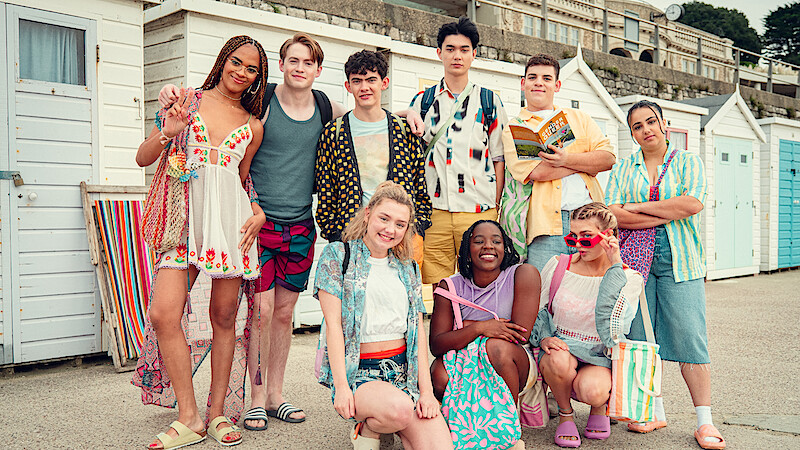
I discovered Heartstopper in early 2024, shortly before I came out as a trans woman. I was looking for queer media with trans representation in it as I was navigating my newfound identity, and I had the show recommended to me by my then-partner and some queer friends. Little did I know how much of an impact it would have on my life.
Heartstopper is a beautiful queer love story about two teenage boys, Charlie Spring and Nick Nelson, who get sat next to each other in class, become friends, and fall in love. Charlie is an openly gay, shy, introverted boy who plays the drums and studies hard, while Nick is the cheerful, popular captain of their school’s rugby team and, after growing close with Charlie, realizes that he’s bisexual.
Charlie and Nick aren’t the only important characters though. Over the course of the show, they build strong friendships with other queer and trans kids with their own identities and journeys through life. These characters include Nick’s friend Tara Jones, her partner Darcy Olsson, and Charlie’s friends Tao Xu, Isaac Henderson, and Elle Argent.
TW: homophobia, transphobia, ab*se, EDs
Elle is my personal favorite character. She is a trans girl who transferred from Truham Grammar, the all-boys school that Charlie, Nick, Tao and Isaac go to, to an all-girls school called Higgs. She initially struggles to fit in, but then makes friends with Tara and Darcy, who help her feel more at home there. Elle is a talented artist that learns to discover, love and express herself through her art, which eventually results in her getting into art school and gaining a massive social media following. She also develops a romance with Tao, the only cis straight friend in the group, who deeply cares for and loves her even to the point of learning to overcome his low self-esteem and fear of abandonment so he can become a better partner. Elle also faces some challenges in building relationships, and transphobia too as her art gets more widely recognized, but she also gets a lot of love and support from Tao, her family, and the rest of her friend group.
Elle’s journey of self-discovery through art also made me feel seen, both as a trans woman and as a writer. I saw a lot of myself in her, since I also struggle to fit into most social spaces despite being an extrovert, and I also have a strong desire to create something new and be embraced by my community. Seeing a trans character so positively represented helped me become more comfortable and confident coming out. Later on, her rise to artistic fame in Season 3 also inspired me to start journaling, and then, start this blog. While I may not be as good at painting or drawing, writing is a valid form of art too!
Her character arc also taught me that I can be myself and still be loved for it. Even though my family and ex partner didn’t support me coming out, I still had people that did, and there’s always room for new friends. Just like Elle’s friends helped her bring out the best in herself, my friends helped me bring out the best in myself too.
Tara and Darcy are also really important characters to me. Tara gives Darcy a safe space to help them escape from their homophobic parents, explore being non-binary, and learn to open up and express their feelings, whereas Darcy helps Tara feel more confident about being a lesbian and comforts her when she struggles with immense pressure to succeed in school. I personally relate more to Tara because I find it easier to express my feelings rather than avoid talking about them, but I can also empathize with Darcy’s family struggles and their need to escape their homophobic mother, as I had to do the same with my father. Their relationship taught me that even though I’ve been made to feel like I’m too different or too much for experiencing feelings more deeply or being a trans lesbian, I won’t be too much for the right person. And when you’re overwhelmed, it’s okay to ask for comfort, space, or anything else you need.
On top of that, although Nick and Charlie are both boys, their stories also resonate very deeply with me. At the beginning of the story, Charlie is stuck in a secret relationship with Ben Hope, a manipulative boy who treats him like a shameful secret, refuses to even ask before kissing him, and only cares to meet up on his terms. He pretends not to know Charlie when other people are around, and gets offended when Charlie refers to the two of them as boyfriends. Meanwhile, he still openly dates girls while the two of them are seeing each other, which leads Charlie to break up with him. Ben’s main reasoning is that he’s “figuring things out”, and mentions later on in the show that his parents are homophobic. However, the show emphasizes through his arguments with Nick that these were explanations, not excuses, and that Charlie did not deserve to be treated like that.
Charlie also faced rampant bullying in the year before the story took place due to being accidentally outed as gay, leaving him with deep trauma and a lasting fear of being a burden to anyone. As a result of that and his relationship with Ben, as Tao puts it, “he’s always had a tendency to believe that him just existing is annoying for other people.” He even develops an eating disorder and severe mental health problems, which he hides from everyone including Nick. But by the events of the third season, his mental health struggles get so severe that he gets hospitalized for them. Thankfully, though, he has a much stronger support system at this point than he did at the beginning. He learns that not only is he allowed to ask for the love and support he needs, but that needing support doesn’t make him weak or a burden, and that being vulnerable with the right people will make his relationships with them that much stronger. He has plenty of people that are happy to love and support him- his friends, his sister Tori, his parents, and of course, Nick.
Nick also has his fair share of struggles too, though. On the surface he’s a popular, cheerful “rugby lad” who laughs and jokes with his “mates”, but he never feels comfortable opening up to them about his feelings. In fact, Charlie is the first person besides his mother Sarah that he starts to feel emotionally close to. Sarah even remarks that Charlie is very different to his other friends, and that he seems much more himself around him. We later learn that his parents divorced when he was very young, and his father has since been very absent from his life, leaving him to hide and abandon his true self to please everyone else. And while his relationship with Charlie ends up becoming very healthy for both of them, he also realizes while exploring potential careers and university options that he doesn’t know who he is without his boyfriend. At the point the story is currently in at the time I’m writing this, he’s still figuring that out for himself.
Nick’s people-pleasing tendencies also affect his relationship with Charlie early on, since he initially keeps their relationship a secret due to not knowing his sexuality yet. However, he still stands up for Charlie in front of his mates and doesn’t mind hanging out with him in public, since he genuinely likes being with him. His friendship with Tara also helps him feel more comfortable coming out, since Tara sharing her own journey through her own lesbian identity and her relationship with Darcy teaches him that he’s not alone. And once he realizes he’s bisexual, he feels liberated and free, like he finally woke up. While he struggles with coming out initially, his enthusiasm and feelings of euphoria are all too apparent when he does, as shown at the end of Season 1 where, on a date at the beach with Charlie, he runs out to the ocean and shouts “I like Charlie Spring! In a romantic way, not just a friend way!!” Charlie may have fallen in love first, but Nick definitely fell harder.
Although bisexual men often face erasure from the rest of the LGBTQIA+ community, Nick is embraced and validated by his new queer friends, further helping him come out to more and more people. Heartstopper also challenges the erasure that bisexual people face, highlighting Nick’s bisexuality even though he’s already dating a boy. His catchphrase when coming out during Season 2 is “I’m bi, actually.”
However, when Charlie struggles with his mental health issues, Nick initially feels pressure to fix everything, since he believes he has to due to being Charlie’s boyfriend. But he learns that although his love and support is important, sometimes people need more support than one person can give. And while he does struggle with feeling helpless and inadequate and the fear of loss, Charlie is still there to support him and make him feel seen, loved, and important. And he does so not out of pressure, but out of genuine love. In the end, Nick doesn’t save Charlie from his struggles, but he does help him save himself.
Overall, Heartstopper portrays romance in a way that most modern media does not. It doesn’t rely on extensive fights or drama to keep relationships entertaining to audiences, but instead shows couples communicating and growing together. In all three main relationships, both partners help the other become happier, more confident, more secure, and more safe to be vulnerable. They learn to love not just their partners, but their friends too. Every character develops a greater sense of self and more emotional maturity out of a desire to be a better partner, a better friend, and a better person. And honestly, it’s really inspired me a lot.
I’ve struggled a whole lot in past relationships. I’ve been used, forced into roles I’m uncomfortable with, neglected, been kept a secret, and left behind when all I needed was someone to truly be there for me. I’ve also had a history of compromising on my own needs and values to avoid disappointing my partner or being treated like I’m entitled, selfish, or “too much”. For a while I’ve struggled with the fear that no one would ever love me the way I wanted to be loved. The fact that the majority of LGBTQIA+ movies and books center homophobia and tragedy with the two partners going their separate ways at the end, and even many mainstream shows with queer relationships in it usually scrap their queer storylines or keep them out of the main pictures, only amplified that fear.
But Heartstopper taught me otherwise. Heartstopper taught me that queer romantic relationships can and do work out sometimes. Not only that, but they can be healthy too. Partners who are willing to make it work can and will rise to meet each other. They won’t leave when their partner starts going through a tough time, try to force them to be someone they’re not out of convenience, or only keep them in a down-low situationship forever. They’ll show up, love their partner openly and passionately, and embrace them as they are, flaws and all. And they won’t just build their own relationship, but be an important part of a loving chosen family full of best friends too. They won’t let anyone make them disappear.
The show also centers the joy of finding queer love and chosen family, and of discovering oneself, rather than just the struggles that queer and trans people face. While it doesn’t shy away from those issues, it doesn’t make them the main focus either. At the end of the day, Heartstopper is a story about love in all its forms. Not just romance, but friendship, given and chosen family, and self-love too.
Heartstopper helped me to believe in love again. I have an immense amount of love for myself and my friends, and even with all that I’ve been through, I firmly believe that there’s a romance out there like that for me. I do believe that I will be loved not in spite of my differences, but because of them. I believe that there is someone out there who will hold me close, show me off, and treat me like they’re so damn lucky and happy they get to be with me, that their life is way better because they met me. After all, if a group of teenagers can learn to cultivate healthy and loving relationships like that, why can’t we?
 Allegra's Trans Experience
Leave a comment